An option must satisfy all the relevant conditions, not just one familiar detail.
A diagram and an email divide the information needed for a decision. The diagram describes what is available; the email explains what a particular person needs. An answer must satisfy both. Finding an activity in a schedule is only the beginning—its time, conditions, and purpose still have to fit the request.
The same attention to detail supports inference, recognition of mood, and interpretation of modal verbs. A conclusion must follow from the information actually supplied.
Use a quick overview to guide a precise search
Allow nine minutes for eight questions when practising Part Two. The reference might be a flyer, schedule, guide, rental comparison, or job advertisement. Short phrases can make it appear easier than a passage, but moving between the reference and an email takes time.
Use Active Reading here too: read with a question in mind, summarize as you go, keep moving past an unfamiliar word, and recognize names as complete units. Skim the diagram first to identify its categories and where information is located. This overview is a search aid, not a demand to memorize every detail. Read the email’s sender, recipient, subject line, and opening—not only its body—to establish who is writing and why. Then return to the relevant part of the reference. A blank may even concern the recipient, so the relationship itself can matter.
Useful keywords depend on the situation: names and organizations, times and dates, distances and locations, prices, occasions, and descriptive adjectives. The email may paraphrase an adjective in the diagram. A business name or address usually needs recognition rather than translation unless the question specifically asks about it.
Make brief notes when several people, events, or time references are involved. Identify which event has already happened and which comes next. The notes should be easy to consult, so a relationship does not have to be worked out again every time a name appears.
Small words can change the decision
Pronouns carry the topic from one sentence to another. If a reference is unclear, return to the preceding sentence instead of silently changing the subject. A connector such as plus can add another point about the same subject, so do not switch its reference to a different option without evidence. A question about the purpose of an email is also different from a question about the purpose of a trip: answering a nearby but different question remains an error.
Words such as but signal that an appealing feature is being contrasted with an objection. The answer after but must fit that contrast, not simply name another feature the writer likes. A missed no can reverse a condition. Similarly, all, everything, and everyone make broad claims that require broad support. A discount on selected items does not establish a discount on every order.
When a question asks what two options both offer, check the feature in each entry. A feature that appears in only one is not shared. Likewise, if the writer says none of the listed options meets a need, check whether a proposed answer is already available before treating it as the missing feature.
A possibility is not the same as an observed result. Saying something can be tiring does not establish that this particular person found it tiring. Nor does learning about other people’s work automatically mean those people were being helpful. Choose the interpretation supported by the actual interaction.
Pronunciation belongs in vocabulary study
Vocabulary work includes listening to a word and noticing its stress. Where a pronunciation reference shows the mouth position, compare that position with your own. Correcting a difficult sound such as R or TH early avoids repeatedly practising the wrong form. This complements the reading work: recognition of a word should include its sound as well as its definition.

Meaning comes from the links between details, not one familiar word.
Worked example: Home vegetable growing guide
The reference compares six crops by difficulty, season, and growing requirements. Alex’s email supplies the conditions that must be matched. Use the growing requirements in the diagram to judge which crop fits each part of the email.
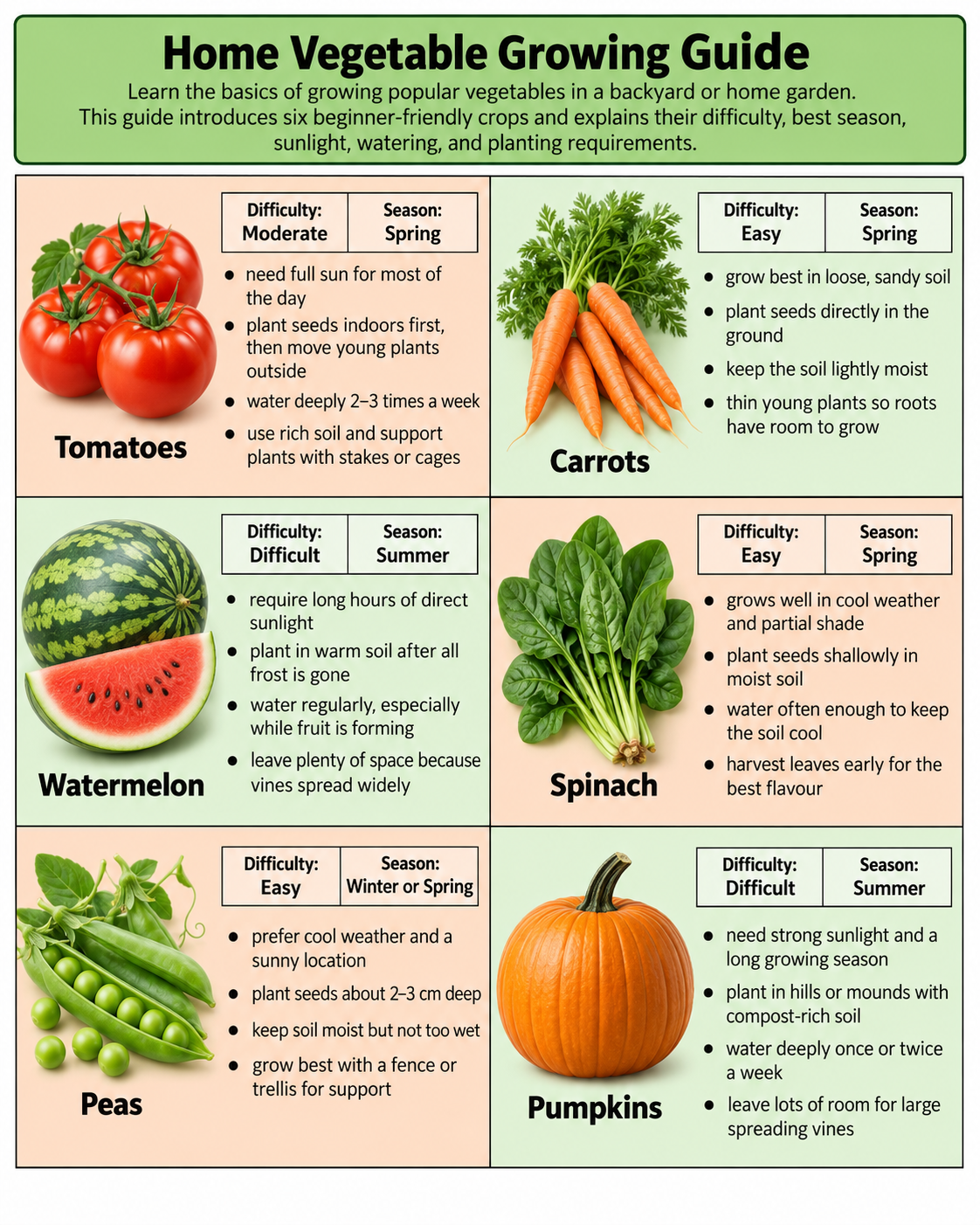
Reference information in text
Tomatoes. Tomatoes are moderate in difficulty and planted in spring. They need full sun for most of the day. Start the seeds indoors, then move the young plants outside. Water deeply two or three times a week, use rich soil, and support the plants with stakes or cages.
Carrots. Carrots are an easy spring crop. They grow best in loose, sandy soil. Sow the seeds directly in the ground, keep the soil lightly moist, and thin the young plants so the roots have room to grow.
Watermelon. Watermelon is marked difficult, with summer as the season. It needs long hours of direct sunlight and warm soil after the frost is gone. Water regularly while the fruit is forming, and leave plenty of room for the vines.
Spinach. Spinach is an easy spring crop. It grows well in cool weather and partial shade. Plant the seeds shallowly in moist soil, keep the soil cool with water, and harvest the leaves early for the best flavour.
Peas. Peas are easy, with winter or spring as the season. They prefer cool weather and a sunny position. Plant the seeds about two to three centimetres deep. Keep the soil moist, but not too wet, and provide a fence or trellis for support.
Pumpkins. Pumpkins are difficult and planted in summer. They need strong sunlight and a long growing season. Plant them in hills or mounds with compost-rich soil. Water deeply once or twice a week, and leave plenty of room for the vines.
Alex’s email
Hi Maya,
I want to begin with an easy crop this spring. My small plot gets some shade and stays cool, so [1] looks like the best match. I also have a sunny strip beside the fence. If I choose peas there, I should provide [2] .
For the loose, sandy bed, I am considering carrots. To give their roots space, I will need to [3] . I like watermelon too, but its long vines and need for strong sunlight make it [4] for my current plot. The guide recommends harvesting spinach early for [5] .
Could you help me check the conditions before I buy seeds? Thanks, Alex
Email blank 1
An easy spring crop for a cool plot with partial shade.
- A. watermelon
- B. spinach
- C. pumpkins
- D. tomatoes
The answer is B: spinach. Spinach: Easy · Spring · cool weather and partial shade.
Email blank 2
For peas beside the sunny fence, Alex should provide blank.
- A. a shaded indoor room
- B. waterlogged soil
- C. a fence or trellis
- D. a glass container
The answer is C: a fence or trellis. Peas need support from a fence or trellis.
Email blank 3
To make room for carrot roots, Alex should blank.
- A. thin young plants
- B. move every plant indoors
- C. cover them with deep shade
- D. grow them on a trellis
The answer is A: thin young plants. Carrots: thin young plants so the roots have space.
Email blank 4
Watermelon’s long vines and sunlight needs make it blank for the current plot.
- A. the only easy choice
- B. suitable for deep shade
- C. ready for winter planting
- D. a poor fit
The answer is D: a poor fit. The plot is small and partly shaded; watermelon needs direct sun and vine space.
Email blank 5
The guide recommends harvesting spinach early for blank.
- A. taller vines
- B. better flavour
- C. winter protection
- D. a lower registration fee
The answer is B: better flavour. Spinach: harvest early for flavour.
Guide question 6
Which pair is labelled Difficult and planted in Summer?
- A. Carrots and spinach
- B. Peas and tomatoes
- C. Watermelon and pumpkins
- D. Tomatoes and carrots
The answer is C: Watermelon and pumpkins. Both watermelon and pumpkins: Difficult · Summer.
Guide question 7
Which action belongs to tomatoes in this guide?
- A. Start seeds indoors, then transplant.
- B. Keep them in partial shade all day.
- C. Plant them only in winter.
- D. Avoid any support.
The answer is A: Start seeds indoors, then transplant. Tomatoes: start indoors, then transplant; stakes or cages are recommended.
Guide question 8
How does Alex feel about choosing crops?
- A. Certain that every crop will work
- B. Angry about the guide
- C. Uninterested in gardening
- D. Interested but checking suitability
The answer is D: Interested but checking suitability. Alex wants to begin, compares options and asks Maya to check conditions.
Worked example: Riverside Garden Centre
This reference combines workshop times with registration, price, and age conditions. Sam’s email narrows the choice to an activity that fits both participants. Check the available activities against their dates, times, and conditions.

Reference information in text
Riverside Garden Centre, 25 Greenway Drive, Oakridge. Open Monday–Friday, 9 a.m.–5 p.m. Each workshop costs $30, with all materials included. Registration is required, places are limited, and participants must be aged 14 or over.
| Day | Workshop | Time | Activity and conditions |
|---|---|---|---|
| Monday | Indoor Plant Basics | 10–11:30 a.m. | Choosing plants; light, water, and soil basics; beginner friendly. |
| Tuesday | Succulent Arrangements | 1–2:30 p.m. | Create an arrangement to take home; materials provided. |
| Wednesday | Vegetable Gardening | 10–11:30 a.m. | Soil preparation, planting, and seasonal care. |
| Thursday | Pruning and Plant Care | 1–2:30 p.m. | Pruning techniques; participants can bring plant-care questions. |
| Friday | Terrarium Workshop | 10 a.m.–noon | Build a glass-container garden; suitable for all skill levels. |
Sam’s email
Hi Ben,
Nora is 15 and would like to join me for a workshop. We are both free on Tuesday and Thursday afternoons. She wants to make something to take home, so I suggest [1] . The two of us attending one workshop would cost [2] .
I also want to learn how to cut back my shrubs properly. For that, I should choose [3] . We should [4] because places are limited. I had hoped to bring my 12-year-old nephew as well, but [5] .
Could you check whether Nora likes this plan? Best, Sam
Workshop blank 1
Nora wants an arrangement to take home on an available afternoon.
- A. Friday’s Terrarium Workshop
- B. Tuesday’s Succulent Arrangements
- C. Monday’s Indoor Plant Basics
- D. Wednesday’s Vegetable Gardening
The answer is B: Tuesday’s Succulent Arrangements. Tuesday: 1–2:30 p.m.; create an arrangement to take home.
Workshop blank 2
What is the total for Sam and Nora to attend one workshop each?
- A. 30 dollars
- B. 45 dollars
- C. 60 dollars
- D. 90 dollars
The answer is C: 60 dollars. 30 dollars per person per workshop × 2 participants = 60 dollars.
Workshop blank 3
Sam wants to learn how to cut back shrubs properly.
- A. Thursday’s Pruning and Plant Care
- B. Tuesday’s Succulent Arrangements
- C. Friday’s Terrarium Workshop
- D. Monday’s Indoor Plant Basics
The answer is A: Thursday’s Pruning and Plant Care. Thursday: pruning techniques and plant care, 1–2:30 p.m.
Workshop blank 4
Since spaces are limited, Sam and Nora should blank.
- A. arrive without contacting the centre
- B. bring every tool themselves
- C. wait until the centre closes
- D. register in advance
The answer is D: register in advance. Advance registration is required; spaces are limited.
Workshop blank 5
Why can Sam’s 12-year-old nephew not attend under the stated policy?
- A. Only adults can attend.
- B. The minimum age is 14.
- C. Tuesday classes are full.
- D. All materials must be bought separately.
The answer is B: The minimum age is 14. Workshops are open to adults and teens aged 14 and above.
Workshop question 6
Which statement about the Friday workshop is supported?
- A. It is suitable only for experts.
- B. It lasts all the centre’s opening hours.
- C. It lasts two hours and welcomes all skill levels.
- D. It takes place on Thursday afternoon.
The answer is C: It lasts two hours and welcomes all skill levels. Friday · 10 a.m.–noon · all skill levels.
Workshop question 7
Which word best describes Sam’s attitude toward the plan?
- A. Interested and practical
- B. Hostile toward the centre
- C. Certain Nora has already agreed
- D. Indifferent to Nora’s preference
The answer is A: Interested and practical. Sam proposes a suitable workshop and asks Ben to check Nora’s preference.
Infer a conclusion from several clues
An inference is not an unsupported guess. Combine details about clothing, actions, objects, and interactions. The supported conclusion should fit the whole situation and the available alternatives.
Paul and Alice
Every day after work Paul took off his muddy boots on the steps of the front porch. Alice would have a fit if the boots made it so far as the welcome mat. He then removed his dusty overalls and threw them into a plastic garbage bag. Alice left a new garbage bag tied to the porch railing for him every morning. On his way in the house, he left the garbage bag by the washing machine and took a shower as instructed. Paul would eat dinner with Alice after he was "presentable," as she often said.
Where does Paul most likely work?
- A. In a cemetery
- B. In a grocery store
- C. In a car dealership
- D. In an office building
A cemetery is the best fit among the four workplaces. Muddy boots, dusty overalls, and the bag used to contain dirty clothes suggest contact with soil; a cemetery can contain grass and earth. A grocery store, car dealership, or office building does not account for those clues as well. The workplace is inferred rather than directly named.
What would Alice find uncomfortable?
- A. Going to a demolition derby
- B. Sitting in a church
- C. Reading in a library
- D. Walking around a museum
A demolition derby best fits the setting Alice would dislike. Her reaction to dirt in the house establishes the concern; have a fit means become angry. The rough, muddy vehicle event described in the exercise contrasts with the other choices—sitting in a church, reading in a library, or walking around a museum.
What is their most likely relationship?
- A. They are best friends.
- B. They are husband and wife.
- C. They are mother and son.
- D. They are brother and sister.
Husband and wife best fits their everyday interaction. Alice prepares a bag for Paul’s work clothes, he showers, and they eat dinner together. The inference rests on their whole everyday interaction rather than one isolated word.
Max and the storm
Crack! Thunder struck and rain poured. Max stared blankly out the window, trying to contain his emotions that raged like the weather. He was beginning to lose it. Dropping the kite from his hand, Max broke out into full sob. His mother comforted him, "There, there, Max. We'll just find something else to do." She began to unpack the picnic basket that was on the counter and offered him a sandwich. Max snapped, "I don't want a sandwich!" A flash from the sky lit up the living room. Boom! Mom sighed.
Why is Max upset?
- A. The weather interrupted his plans.
- B. He really hates sandwiches.
- C. He is afraid of thunder.
- D. He cannot get any TV channels because of the storm.
The weather interrupted his plans. The storm, dropped kite, tears, and his mother’s promise to find something else to do combine to support that conclusion. The passage does not establish that Max hates sandwiches, fears thunder, or cannot receive TV channels because of the storm; those alternatives do not explain the full situation.
What had his mother planned?
- A. Mom wanted to fight with her son about lunch.
- B. Mom wanted to have a picnic lunch at the park.
- C. Mom wanted to chase storms to get footage for her YouTube channel.
- D. Mom wanted to stay home and play board games.
A picnic lunch at the park fits the picnic basket being unpacked on the counter. Taking food out of the basket at home, rather than taking it outside, connects the abandoned outing to the storm. The other suggested activities have no support in the passage.
Tommy and the broken window
"Tommy!" Mom called as she walked in the front door. "Tommy," she continued shouting, "I sure could use some help with these groceries." There was still no reply. Mom walked into the kitchen and put the grocery bags on the counter. Then she noticed shattered glass from the picture window. The shards were scattered across the living room floor and a baseball was not far from there. "I'm going to ground you forever, Tommy!" Mom yelled to herself. She now realized that Tommy's shoes were gone.
How did the window most likely break?
- A. Tommy broke the window playing baseball.
- B. A burglar broke in while Tommy was away and the home was unattended.
- C. Mom broke the window with the grocery bags.
- D. Tommy broke the window with his shoes.
Tommy most likely broke the window while playing baseball. The nearby baseball and scattered glass establish the link; shards means small pieces of broken glass. His mother has just arrived, so the groceries do not explain the damage. No burglar is mentioned. The missing shoes indicate that Tommy left, not that a shoe broke the window.
Why did Tommy leave?
- A. He feared his mom’s reaction to the window.
- B. The burglar kidnapped Tommy.
- C. He did not know that he broke the window and continued playing.
- D. He ran to the store to get a new window.
He was afraid of getting into trouble with his mother. Her threat to ground him establishes her anger, while the broken window and missing shoes explain his departure. There is no evidence of a burglar or of Tommy leaving to buy another window.
The classroom mailboxes
Today was a special day in Ms. Smith's class. The kids were finishing their cardboard mailboxes. Johnny colored a cool flame on the side of his race car mailbox. Then he strutted over to Veronica's desk and put a small envelope into her princess castle mailbox. Veronica blushed and played with her hair. Johnny winked and smiled. Bartleby stood by and watched. He was red-faced and sweating. Then Bartleby frantically put small, white envelopes into everyone's mailboxes. After giving one to Ms. Smith, Bartleby pulled out a large red envelope. Veronica's name was neatly written on it. Bartleby blushed. He tried to put it in Veronica's mailbox. It didn't fit. Bartleby struggled with it for a few seconds. Then he ran away with it. Veronica rolled her eyes and popped her gum.
Why is it a special day?
- A. They are celebrating Valentine’s Day.
- B. They have a substitute so everyone is acting wild.
- C. They are serving tacos in the cafeteria and the kids are excited.
- D. They are presenting their science fair projects.
Valentine’s Day fits the mailboxes, envelopes, and children’s reactions even though the occasion is not named. Blushing means becoming red-faced, perhaps through shyness or embarrassment. A substitute teacher, cafeteria tacos, and a science fair are not mentioned.
Which boy does Veronica like?
- A. Veronica likes Johnny.
- B. Veronica likes Bartleby.
- C. Veronica likes the substitute.
- D. Veronica does not like any of these boys.
Johnny receives the more positive response. Veronica blushes and plays with her hair after receiving his envelope, while he winks and smiles. Her eye-rolling response to Bartleby provides a contrast that supports the choice.
Why does Bartleby run away?
- A. Bartleby feels awkward because he likes Veronica.
- B. Bartleby is competitive and wanted to race Johnny back to his seat.
- C. Bartleby is allergic to Veronica’s chewing gum.
- D. Bartleby did not want to get in trouble for leaving his seat.
Bartleby feels awkward because he likes Veronica. His red face, sweating, and difficulty with the envelope indicate embarrassment. Frantically adds a sense of being flustered. The passage supplies no direct competition, allergy, or rule against exchanging envelopes to support the alternatives.
Read the mood of the whole scene
Mood concerns the feeling created by the situation and its details. A question asking which word does not fit requires an incompatible description, not another plausible feeling. Silence can be tense; humour need not be sarcastic.
A cancelled game
Trey looked out the window. The rain was still pouring down. He threw his baseball glove on the couch with a sigh. The thunder cracked and his phone dinged. Trey picked up the phone. It was a message from his cousin: The game is cancelled because of the weather. Trey didn't reply to the message. He threw the phone back on his bed and rubbed his temples. The rain pattered on the roof.
Which word does NOT fit the mood?
Promising is the word that does not fit. It suggests hope, whereas melancholy, gloomy, and disappointing fit Trey’s sadness at being unable to play. The negative wording of the question requires the incompatible description.
Brett and the test
Brett sweated in his chair. The clock in the classroom ticked loudly. Brett looked at the test question again. He had no clue what the answer was. His teacher paced around the room. Brett felt like the teacher was circling him, specifically him, not the rest of the class. "Remember, this test determines your future," the teacher said. Brett read the choices again, but they all blurred into a meaningless word soup. He could not concentrate. The clock kept ticking and the second hand sounded like a butcher's knife slamming down on a cutting board. "Time is running out," said the teacher. Brett's heart pounded.
Which word does NOT fit?
Prepared conflicts with not knowing the answer, being unable to concentrate, and feeling a pounding heart. Doomed, hurried, and nervous fit the pressure. The description makes the ticking clock feel threatening rather than ordinary.
Kiki and Bitty
Kiki the Cat licked her lips and stared at Bitty the Bird, who was singing a silly bird song in her cage. Cartoon noises played in the background as the children watched TV. Kiki tiptoed to the edge of the kitchen counter. Bitty kept singing, unaware of the creeping cat, but aware that she was protected by the metal birdcage. Kiki went for it. She sprang toward the birdcage, but as she did she slipped on some milk on the counter that the children had spilled. Kiki fell off the counter and landed in the trashcan. The lid closed on the milk-covered kitty. Laughter played on the television. Bitty kept whistling.
Funny does not mean sarcastic
Sarcastic does not fit the cat’s tiptoeing, slipping, and landing under a trashcan lid. Funny, silly, and humorous describe the scene. Sarcasm involves mocking or an ironic edge, which the physical comedy does not establish.
The final free throw
We thought the game was over. The buzzer rang and we thought that we had lost, but then the referee blew the whistle. A foul was called and now Derrick had a chance to win the game for us. He stepped up to the free-throw line. The stadium, though filled with people, was completely silent. Everyone was still. Derrick dribbled the ball a couple times. He squared up on the line. Sweat beaded on his forehead. All eyes were on Derrick.
Silence can still feel tense
Peaceful is incompatible with the situation despite the silent stadium. The player suddenly has a chance to win while everyone watches, creating a dramatic, tense, or uneasy atmosphere. Silence alone does not establish calm.
Katie makes a card
Katie cut out the construction paper heart with great care. Her hand moved with precision. This was not going to be an ordinary Valentine's Day card. Katie was going to make it special. She went over the penciled letters with her nice pen. Classical music played in the background. Katie made fancy cursive letters. Slowly, gently, she pasted the lace to the edges of the heart. Her mom was going to love this card as much as Katie loved her. It was almost complete. Just a few more special touches to go.
Careful, creative work
Wasteful is unsupported. Making the card is constructive; the craft activity is artsy; and carefully tracing letters, adding fancy writing, and pasting lace slowly and gently make deliberate appropriate. Those details show purposeful care.
Duncan is home alone
Duncan balled his test paper and threw it in the trash. He hit the bed with a crash and started crying. "I don't care anymore," screamed Duncan in between sobs. He wished that somebody would check on him, that someone would help him through this, but there was no one. He was home alone again. "What does it matter?" he screamed. Nobody responded. The house was empty. Duncan's sobs echoed.
Which feeling is absent?
Accomplished would indicate satisfaction in an achievement, which conflicts with Duncan crying alone without anyone checking on him. Alone, upset, and depressed fit. In the description of his sobs, echoed is a verb, although echo can also be a noun.
Farmer Dave starts the day
Farmer Dave woke to the sound of the rooster's crow. The sun was peeking over the horizon. Dave wasted no time getting ready. He wanted to get to the field and start planting. The TV news prattled on while his wife made coffee. He paid no mind to either. He was working out his strategy for today, going over the rows in his mind. He had barely taken two bites of his toast when he grabbed his boots. "I've got to get a move on it," said Farmer Dave. His wife rolled her eyes and gave him a kiss. The day began.
Driven rather than restful
Restful suggests relaxation, whereas Dave wastes no time, wants to begin planting, and is already planning his work. Driven, focused, and productive fit the activity and attitude established at the beginning.
A warm welcome home
Thomas walked into the kitchen and the smell of fresh baked cookies filled his nose and lifted his heart. "Thomas? Are you home already?" asked his mom. "Yeah, Mom, I've got some homework to do." She gave Thomas a big warm hug and said, "I wanted to surprise you with some cookies." Thomas smiled and said, "You did, Mom. What a great surprise." He took a bite of one and the gooey chocolate chips dissolved on his tongue.
Which word conflicts with the scene?
Abandoned conflicts with the mother’s cookies and warm hug. Her actions support loving, warm, and nourishing. The mood follows from what she does for Thomas.
Stanton carries the message
The cold wind whipped as Stanton raced against it. This was no night for a calm ride. The horse's hoofs clicked as Stanton whipped the reins. He clutched the king's message in one hand and his crossbow in the other. A wolf howled. He saw motion in the bushes ahead. Not a good sign. It could be an ambush. Stanton extended his finger over the trigger of the crossbow. More wolves howled together.
Look at the danger in the details
Harmonious suggests peaceful coexistence, which conflicts with wolves, a weapon, and the possibility of an ambush. Tense, perilous, and dangerous fit those details; perilous means dangerous. An ambush is an attack from a hidden position.
Jane in the field
Jane stretched her arms out and relaxed in the grassy field. The sun warmed her skin and the breeze tussled her hair. The insects hummed and worked and while the world turned, Jane did nothing at all. She took a deep breath and let it fall from her lungs. The brook trickled its secrets and the sounds of nature blended into the symphony of the spring. Jane was in no hurry at all. She was at rest.
The opening gives you the mood
Harsh conflicts with the relaxed condition established in the opening. Peaceful, relaxed, and tranquil fit; tranquil means peaceful or calm. The surrounding description supplies the feeling, even without relying on a single emotion word.
Modal verbs express ability, possibility, and permission
Modal verbs help express ability, possibility, permission, and obligation. Can, could, and be able to can express ability; may and might can express possibility. Should concerns what someone ought to do, while must and have to can express an obligation. The intended meaning and the form of the following verb must both fit.
Ability across time
After can or could, use the base verb without to or an -ing ending: Tom can write poetry very well, I can help you with that next week, and Lisa can't speak French. Earlier ability appears in When I was a child, I could climb trees and Tony could run long distances when he was a boy. The time expression establishes the past context; run and climb remain in the base form.
With be able to, the form of be changes: Mike is able to solve complicated math equations; The support team will be able to help you in about ten minutes; I won't be able to visit you next summer. Compare I wasn't able to visit her in the hospital with He hasn't been able to get in touch with the client yet. In the latter, the problem is still unresolved up to the present.
Context can determine the negative. In The students aren't able to buy their textbooks today. The bookstore is all out of them, all out means that none are in stock. Reading only the first sentence would miss the reason for choosing a negative form.
Possibility and polite requests
You can catch the train at 10:43 presents an available possibility. I could fly via Amsterdam if I leave the day before is less definite. Use could for polite requests to someone less familiar: Could I please have a latte?, Could I talk to your supervisor, please?, and Could you please call a tow truck for me? My car broke down.
In Can you teach me how to fix my computer? You're so good at it, can fits the friendly request; could is also possible as a more polite alternative. The relationship matters. Will you be able to reach the customer if you call him at 4 p.m., his time? concerns a future call. Reordering it as If you call him at 4 p.m., his time, will you be able to reach him? makes the condition easier to recognize.
May and might in context
Permission appears in You may start your exam now and May I have your autograph?; an offer appears in May I help you? The negative can prohibit an action: You may not wear sandals to work. In You may not park your car here. It is reserved for guests of the hotel only, the second sentence supplies the restriction. The word only is part of the meaning.
We may go out for dinner tonight. Do you want to join us? presents a possibility rather than a definite plan. In They might finish the project on time. The main engineer is ill, the illness explains the uncertainty. Interpret may and might through the surrounding situation rather than assigning them fixed numerical probabilities.
Several expressions are useful as whole phrases. You may as well come inside. John will be home soon offers a sensible alternative to waiting outside. He may as well visit the Louvre. He is in Paris anyway uses the same relationship. You might like to try the salmon fillet. It's our special today and You might want to stop by the museum gift shop on your way out make polite suggestions.