Describe what is visible. Predict only what the visible actions make plausible.
A picture response becomes easier to follow when it has a clear route. Description selects visible details and connects them; prediction uses those same details to explain reasonable next actions. The same park scene can support both a detailed description and a prediction about what happens next.
One scene, two different jobs
Task 3 describes what is happening in a picture. Task 4 uses the same picture to predict what is likely to happen next. The people and objects can remain the same, but the purpose of the response changes.
For Task 3, you have thirty seconds to prepare and sixty seconds to speak. Imagine that the listener cannot see the picture. The description needs enough detail and organization for that person to build a mental image. It does not need to mention every object.
Task 3 question: Describe what is happening in the park picture to someone who cannot see it.
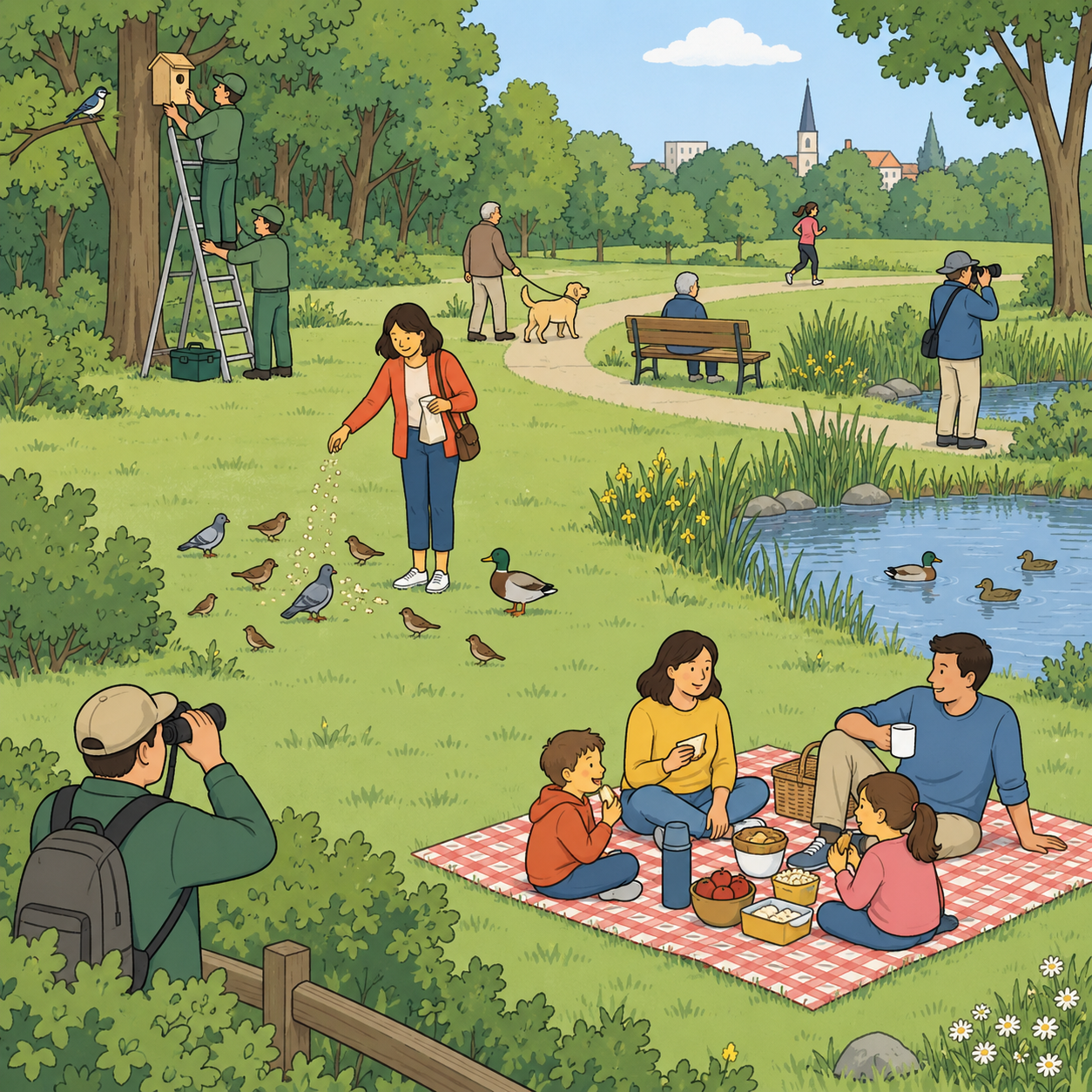
The same scene supports both a description of present actions and reasonable predictions about next actions.
Choose material that gives you something to explain
You can develop the description around the people or the setting. When the actions are easy to name, concentrate on roughly four groups of people. Identify their locations, clothing and activities. When there are fewer people, or some actions are difficult to describe, use more of the setting and combine it with two or three groups.
The park contains useful material in both categories. A picnic group provides people, a blanket, food and an activity. The setting includes paths, trees, a pond and a bench. The choice is therefore about which details can be described clearly within the time, rather than which details appear most complicated.
People and setting receive the main attention. Hair, clothing and action help identify people; weather, furniture, visible quantities and other objects help establish the surroundings. An object can provide extra detail when more content is needed. If several people are doing similar things, their clothing, expressions or nearby objects can distinguish them. A relaxed, happy or delighted expression may add useful information without inventing a different activity for each person.
Model 1: people and actions
This picture shows a busy park. In the foreground, a family is having a picnic on a red-and-white blanket. Two adults are sitting with two children, and there are several containers of food in front of them. Near the centre, a woman in an orange cardigan is scattering food for the birds around her. On the left, two workers are putting up a wooden birdhouse. One is standing on a ladder while the other holds it steady.
On the right, a man beside the pond is looking through binoculars. Farther back, a man is walking a dog and a woman is jogging along the path. These are the main activities I can see in the park.
This version builds the description around the picnic family, the woman feeding birds, the workers and other visible activities. Position phrases introduce each area. The ladder detail develops what the workers are doing instead of merely naming them.
Model 2: setting and selected people
This picture shows a lively park with tall trees and several paths. Some buildings are visible beyond the trees in the background. There is a pond on the right, and a wooden bench near the middle of the scene. In the foreground, a red-and-white picnic blanket is spread out on the grass. A family of four is sitting around several containers of food. The woman is wearing a yellow top, and the man beside her has a blue shirt.
On the left, two workers in green are putting a birdhouse on a tree. One worker is standing on a ladder, while the other is holding it steady. Near the centre, a woman in an orange cardigan is feeding the birds. The trees, paths and different activities make this a busy outdoor scene. These are the details I can pick up from the picture.
This version establishes trees, paths, buildings, the pond and the bench before describing selected people. The setting and actions support each other: the blanket and food establish the picnic, while the ladder explains the workers' activity. Both models answer the same question; their emphasis differs.
Give the listener a route through the picture
An ordered description keeps nearby details together. It can move from top to middle to bottom, or from left to right. There is no requirement to follow one fixed route, but returning repeatedly to an area already left behind makes the listener work harder.
Use positions visible in the image. North, south, east and west should not be invented when the picture supplies no compass directions. These phrases locate details in the picture:
| Part of the image | Phrase |
|---|---|
| Top or bottom | at the top, at the bottom |
| Left or right | on the left, on the right |
| Middle | in the middle |
| A corner | in the top-left corner, in the bottom-right corner |
For a corner, the vertical position comes first: top-left, not left-top. Keep the word “corner” in the phrase. These are location expressions for describing pictures, rather than a universal rule for every use of at, on and in.
Relative positions make a description more precise. Between locates something among two reference points. Next to means beside: the birdwatcher is next to the pond. Behind and in front of establish depth: the person on the bench is behind the woman feeding birds, while the picnic family is in front of the pond.
Near and far express distance within the scene. The birds are near the woman, and buildings are far in the background. Above and below describe higher and lower positions: the birdhouse is above the worker holding the ladder. Under can describe something directly beneath another thing. These expressions should help the listener locate a detail, rather than simply decorate the sentence.
Straight ahead describes continuing in the same direction: “The car is going straight ahead.” On the corner can locate a building where streets meet: “The café is on the corner.” This street corner differs from in the top-left corner of the picture, which locates something within the image.
Keep the framing short and the connections clear
A prepared opening can identify the setting and the purpose:
I see a picture resembling a park. I'll try to describe it well so you can imagine it vividly too.
There is a picture in front of me that looks like a park. I'll do my best to describe it to you.
The place name changes with the image. Short endings such as “These are my observations from the picture” or “These are the details I can pick up from the picture” leave time for the description itself.
The length is flexible. When there is plenty to describe, shorten the introduction and conclusion. When the description is brief, slightly fuller framing can help use the available time, while still leaving the main attention on the picture.
Vocabulary for actions, objects and people is especially useful in this task. Sentence variety can come from straightforward connections:
One worker is standing on the ladder while the other is holding it steady.
A woman in an orange cardigan is feeding birds, which are gathering around her.
“While” connects simultaneous actions. The second sentence adds information about the birds. There is no need to make every sentence use a different complex structure; variety should support fluency and clarity.
Identify people accurately with language you can use
Hair and clothing offer many ways to distinguish people. Hair may be curly, wavy, short or long. Blonde refers to light-coloured hair; brunette or dark brown can describe brown hair. Useful clothing words include shirt, T-shirt, tank top, vest, blouse, sweater, jumper, skirt, trousers and dress. A blouse commonly refers to a woman's shirt, while sweater and jumper describe similar knitted clothing.
A striped shirt, a uniform, or a cap with two colours can identify a particular person. Side by side means next to one another. For sizes, the word precedes the number: size ten. For one item of jeans, the expression is a pair of jeans. More specific clothing words, such as dungarees or flared trousers, are useful additions to vocabulary, but they should not cause a long pause during a response. A broader accurate description—“a purple top,” “a pair of trousers” or “clothing”—can preserve the meaning.
A tapered haircut gradually becomes shorter towards the sides or neckline; fuchsia names a bright pink-purple colour. Seemingly can qualify an impression: “The seemingly relaxed shopper is looking at a display.” Use a precise term when it is familiar and supported by the image; a clear broader term is still useful. Attire also means clothing.
Place names need the same accuracy. A toy-selling area can simply be the toy section, rather than “children's product section.” A shop may be a store, boutique or department store, depending on what is visible; “shopping store” is not the intended expression. An object mentioned again can become more specific when the word is known: a “toy” may be identified as “a miniature truck” or “a soft toy.”
A section is an area of a store devoted to a type of product; a counter is a surface or service point where someone may be served or pay. As a verb, showcase means present or display something: “The picture showcases a busy moment in a store.” Outside, a fire hydrant and a sparrow are more specific than “an object” and “a bird,” while fluffy describes a soft, full-looking texture.
Accuracy also includes familiar grammar and complete actions. More than one child is children, not “two child.” Going upstairs includes the action that “to upstairs” leaves out. If a movement is hard to describe but the people visibly look happy, “They look like they're having fun” can communicate a reasonable observation. Choose details supported by the picture; do not force an object into a label that clearly does not fit.
There is room for a reasonable interpretation of an unclear drawing. A flight of steps may be described as stairs when it is not clear whether it is an escalator. Calling the same visible steps an elevator, however, changes the object. If the precise word is unavailable, use a reasonable broader description or move to another part of the scene.
Prepare enough detail without getting trapped by one item
Short notes can hold a location and a key detail: “bottom-right—picnic family” or “left—workers, ladder.” Abbreviations are useful if they quickly recover the intended idea. Full paragraphs are unnecessary.
Pace affects how much of the plan reaches the listener. Speaking too slowly can leave useful details unexplained, while rushing can make words indistinct. If one unfamiliar object threatens to use ten seconds of a sixty-second answer, select another detail and study the missing vocabulary afterwards.
Pronunciation deserves continuing attention. “Walking” and “working” communicate different actions, so their distinction matters. “Visualize” should become one recognizable word rather than disconnected pieces. Practise slowly at first, then connect the sounds. Reliable examples can also help with difficult sounds such as th and r. Repeatedly practising an incorrect sound makes the habit harder to change; checking it before repetition is more effective. Connected phrases should become smooth without losing the small words that hold the sentence together.
Change from description to prediction
Task 4 question: Using the same park picture, explain what will most probably happen next.
Aim to develop four or five predictions. Reusing groups already described in Task 3 saves thinking time: their locations and identities are already familiar. The response can then focus on the workers, the woman feeding birds, the picnic family and the dog walker without having to discover a completely new set of people.
Reusing the same groups is a time-saving preference, not an absolute restriction. If they do not provide enough useful predictions, another visible group can be included.
Complete prediction model
The worker on the ladder will probably finish attaching the birdhouse and climb down. His colleague may keep holding the ladder until he reaches the ground. The woman feeding the birds might scatter a little more food, and the birds may move closer to her. The family will probably continue their picnic. When they finish eating, they may pack the containers into the basket and fold the blanket.
Finally, the man with the dog will probably carry on along the path. These are possible next actions that fit what we can see in the picture.
Each prediction grows from a visible action. Finishing work on the birdhouse leads to climbing down. Feeding birds leads to birds moving closer. Eating a picnic leads to packing up. Walking the dog leads to continuing along the path. The answer uses the scene as evidence for plausible next steps.
The model does not require one uniquely correct future. A reasonable guess is enough. Ordinary possibilities—going home, going to work, visiting a library or catching a train—can provide ideas when they fit the actual person and situation. Preparing ordinary possibilities reduces the pressure to invent an elaborate story.
Develop the next action rather than repeat the present one
“The man is walking his dog” remains a Task 3 description. “He may continue around the pond and then head home” moves the action forward. Likewise, “The family is eating” becomes a prediction when it develops into putting the food away after the meal.
A reason can make the prediction clearer: “The birds may move closer because the woman is scattering food.” Reusing the food detail from Task 3 is useful here because it now explains a future action. Position phrases can still identify the people: the workers on the left, the woman near the centre, or the family in the foreground.
One or two connected actions per group can be enough. Imagining an entire afternoon for one person can prevent the other predictions from being developed. Finishing the picnic and packing up is a manageable sequence. If no sensible prediction comes to mind for one person, another group is available.
Language that keeps the answer future-focused
“They will…,” “They are going to…” and “They might…” help signal the future. If every sentence merely describes what people are doing, the response has not changed tasks. The form of a word also matters: hesitate is a verb and hesitant is an adjective. When an unfamiliar form causes a pause, continue with a clear alternative and review the missing word afterwards.
An opening can be as short as “Based on the picture, I'm going to make a few guesses.” Other options are “I'm going to guess what might happen next” and “All right, let's make a guess about what's going to happen next.” A brief ending—“That's my prediction for this scene” or “That's my guess for how the scene will play out”—closes the answer. Play out means how events develop. The predictions themselves should receive most of the time.
Carry descriptive skills into personal stories
Concrete description also makes a personal-experience story clearer. A vehicle-help story becomes clearer through relevant words such as pickup truck, low oil pressure light and significantly overdue. Expertise means specialist knowledge or skill; ample experience means a great deal of experience. The detail matters because it explains the event, not because it sounds impressive. Despite can connect a difficulty with an action taken anyway, while nevertheless can mark a change.
Emotion can be communicated through a visible detail. In the animal example, mud on a dog's face is compared to a moustache. “A big, innocent smile” and “an adorable expression” explain why the speaker laughs. I couldn't help but laugh means the laughter was hard to stop. Precious describes emotional value, such as a moment worth remembering.
A new experience can combine confidence and uncertainty: someone may have useful skills yet still feel nervous about a new situation. Considerable expertise means substantial knowledge; accumulated experience has built up over time; and immersed myself means giving full attention to an activity. Upon arriving introduces what happened when the person arrived.
These details support the same Storyline Principle: what happened, how the person felt, what changed and what resulted. Checking the question against that sequence keeps description connected to the task instead of becoming an unrelated collection of vivid words.