Support your opinion with distinct reasons; describe an unusual scene for someone who cannot see it.
An opinion answer needs reasons that explain a position. An unusual-scene answer needs details that let another person imagine what cannot be seen.
Task 7: choose a position that can be developed
Opinion questions often concern social issues such as government policy, education or family life. Choose a clear position quickly and use most of the preparation time to develop two reasons. An introduction, two developed reasons and a conclusion provide a manageable structure.
The tone is somewhat more formal than advice to a friend in Task 1. Connecting language and accurate complex sentences can explain relationships between ideas, but formality should not make the answer difficult to follow.
Question: pets in rented homes
Do you think landlords should allow their tenants to keep pets in the homes they rent? Explain your reasons.
Either position can be developed. The model supports allowing pets with tenants taking responsibility for their animals. Its first reason concerns the place of pets in home life; its second concerns clear expectations for responsible behaviour.
Complete opinion model
I believe that each perspective has its valid reasons. However, I think landlords should allow tenants to keep pets, provided they take responsibility for them. The first reason is that pets are an important part of many people's home life. For example, someone may have cared for the same dog for years. Having to give it up simply because they need to move could be extremely upsetting. Allowing pets would give that person more housing choices and let them keep a familiar companion. This could make the change of home less stressful.
Speaking of responsibility, allowing pets with clear expectations could encourage tenants to be considerate of others. They would need to control noise, keep shared areas clean and deal with any damage their pet caused. For example, a dog owner could make sure their animal doesn't disturb neighbours in a shared hallway. Different homes and animals may need different arrangements, but reasonable conditions could help balance the needs of tenants, neighbours and landlords. In conclusion, I think allowing pets with clear responsibilities would be beneficial to people who rent their homes.
The opening states the position plainly. The first reason explains why losing a long-time pet could make moving more upsetting, and why allowing the pet could give the tenant more housing choices. The second reason gives responsibility a concrete meaning: controlling noise, keeping shared areas clean and addressing damage. The conclusion returns to the position rather than adding a new argument.

A position becomes clear through its reasons and their consequences for the people involved.
Build reasons rather than a list of positive words
The 3-1 Principle, or Three Ones Principle, develops an idea through a point, an explanation and an example. In the model, “pets are important” would be too short by itself. The moving difficulty and the example of a long-time pet owner show what that importance means. Similarly, responsibility becomes understandable through specific actions around noise, cleanliness and damage.
Use the structure flexibly. A reason with two useful explanatory sentences can already be developed, even without a separate example. If the explanation is too brief, an example is a useful way to make it fuller. The objective is meaningful development, not filling three spaces with sentences that repeat one another.
Broad labels need a clear object and result. “Fair” raises the question fair to whom? “Beneficial” raises beneficial in what way? For the rental question, comfort, housing choice and the needs of neighbours are specific directions. A response becomes more convincing when the listener can follow the cause and consequence.
Ten directions for finding a reason
When ideas are difficult to find, consider these ten possible advantages:
| A choice might be… | A choice might also be… |
|---|---|
| More cost-effective | More time-efficient |
| More environmentally friendly | Safer |
| More educational | Healthier |
| Fairer | More convenient |
| More comfortable | Easier |
These are thinking prompts, not ten claims to include in every answer. Comfort and convenience may help explain a tenant's home life. Fairness may direct attention to other people in the building. Each chosen direction still needs an explanation tied to the question.
Keep the position clear under time pressure
Choosing one side makes a timed response easier to organize. It does not mean that another view can never be mentioned. The model acknowledges concerns about neighbours and damage while retaining its position in favour of allowing pets with responsibilities.
Discussing both sides is a possible way to build a coherent response, but it is harder to organize under time pressure. It does not automatically require four reasons. The explanation must make the relationship between the views clear rather than becoming contradictory. Choosing one position is a practical default when it helps you develop two reasons fluently; it is not a rule that an opposing view may never be discussed.
Make each connector perform its actual job
An introduction can acknowledge multiple perspectives and then state the position:
I believe that each perspective has its valid reasons. However, I agree that tenants should be allowed to keep pets, for the following reasons.
A shorter option is “Personally, I believe that tenants should be allowed to keep pets. Allow me to explain why.” Another starts from the opposite view: “I know some people don't think landlords should allow pets, but I disagree for two reasons.” In that version, the first clause is the view being rejected; the reasons that follow must support the speaker's own view. Misreading the template can accidentally reverse the intended position.
| Function | Useful expressions |
|---|---|
| Introduce the first reason | first of all; to begin with; to start with; initially; firstly |
| Explain it | this is because; the reason for this is; the rationale behind this is |
| Give an example | for example; for instance; to illustrate; take myself for example |
| Add the second reason | in addition; furthermore; moreover; what's more; on top of that |
| Lead into a fuller explanation | I believe this to be true because; I say this because |
Choose an expression that can be used smoothly. After “this is because,” the listener expects an explanation; after “for example,” a specific illustration should follow. “In addition” adds a point, whereas “in conclusion” introduces the ending.
A relevant word can also connect paragraphs. The model's “Speaking of responsibility” carries a concept into a second paragraph that actually discusses responsibility. It works because the relationship is real, rather than because the phrase sounds sophisticated.
A conclusion should restate the position and match the people affected. “In conclusion, I think allowing pets with clear responsibilities would be beneficial to people who rent their homes” fits this question. The final group of people must change when the topic changes. “All in all, I think this approach should be implemented” is suitable only when an approach has actually been proposed.
Prepare ideas and language together
Reading and listening about social issues supplies both vocabulary and ways of explaining a position. Notice how a text develops an educational choice, policy or disagreement. Topic-specific words can be more formal than everyday chat, but their meaning still needs to be accurate. Paraphrase naturally when possible without forcing a replacement for every specific term.
Some expressions extend the available range: anticipate can mean expect something to happen and may replace “predict” in that meaning; empower means give someone the ability or confidence to act; and explore your interests means learn more about what interests you. Pronouns such as “they” and “them” can avoid repeated nouns when their reference is clear. These choices add variety only when they preserve the meaning.
Devote time or effort to an activity means give that attention to it; contribute to a result means help bring it about. Wholehearted describes complete, sincere commitment, while wholeheartedly describes how someone acts. A business model is the way a business operates, not “a business mode.” Use the word in a clear explanation: an extensive professional network may connect someone with companies and help them find a position. Those intermediate steps make “a good network” meaningful.
Notes should hold the position, the two reasons and the direction of their development. A connector such as “first of all” or “furthermore” can remind the speaker where to begin a point. When keywords alone are insufficient, add two or three reminders for the detail and one for the example. The notes should recover the intended explanation, not attempt to compose every sentence.
Overthinking can send a reason in several directions at once. Stay with the planned point and use the notes to recover its structure. If a phrase is difficult to say because similar words keep colliding, simpler wording can preserve the idea and the flow. The harder expression can be improved afterwards during practice.
Task 8: describe what is unusual and complete the request
Task 8 may show an unusual activity involving people or an unusual object. The situation supplies more than a picture: it identifies the person being addressed, the setting and any final action the answer must perform.
For example, a question about an unusual object might ask whether it should be bought. A detailed description without that final question would leave the task unfinished. The listener cannot see the object, so the description must make sense as a real conversation with that person.
Question: describe an unusual scene
Tell your mother about the picture below. Describe what you see and ask what she finds unusual.

A snowman stands among autumn colours, with only a small patch of snow at its base.
Complete description model
Hi Mom, I've come across a really unusual scene that I want to describe to you. There's a snowman standing on the grass, with a tall black hat and a red band around it. It has dark eyes, a long orange carrot nose and black buttons down the front. A red-and-orange checked scarf is wrapped around its neck, and two thin branches stick out as arms.
The strange thing is that the trees around it still have bright orange and yellow leaves. There are pumpkins on the ground and fallen leaves scattered across the grass. Only a little patch of snow is visible around the snowman's base. So, what do you think is unusual about this scene?
The model identifies the object first, then its hat, face, buttons, scarf and arms. It moves from the snowman to the autumn surroundings and ends by asking the mother what she finds unusual. The contrast is already visible, so the response does not need to invent another setting or a complicated explanation for how the snowman arrived there.
Let the image determine the structure of the description
For a picture centred on an object, start with an overall identification and then describe colours, shape and visible parts. For a scene with people, establish the scene and the people before explaining their unusual activity. In both cases, most of the response is description, with a short introduction and ending around it.
Position words guide the listener: the snowman's hat is on top, the scarf is around its neck and pumpkins are on the ground beside it. A clear order prevents details from becoming an unrelated list. If a buying question requires it, size, material or suitability may also matter. Added details should remain reasonable and relevant to the actual task.
For a buying scenario, an unstated size, price or background detail can be imagined to make the conversation concrete. A painting, for example, could be described as a suitable size for the living room, made by a local artist and offered for a plausible price. These details help explain the purchase question. Keep the visible object and any fixed conditions, such as the stated location; plausible elaboration does not mean replacing the scene with another one.
These openings fit the two types of picture:
Hi Sally, I'm calling because I found some people doing something odd yet interesting.
Hi Sally, I found something unique that I want to tell you about.
The name and setting must match the prompt. If a name is supplied, use it. If the listener is an unnamed family member, “Mom” or “Dad” can provide a natural form of address. A specified location should remain the location; it should not be replaced merely because another scene is easier to discuss.
Choose an ending that finishes this task
| Situation | Possible ending |
|---|---|
| Reporting a problem | “This is what I'm seeing right now. Can you please send help?” |
| Asking whether to buy something | “So what do you think? Do you think I should buy it?” |
| Sharing an interesting activity | “I wish you were here to see this. Would you like to try it with me?” |
| Describing the snowman to your mother | “What do you think is unusual about this scene?” |
These endings perform different actions. One memorized conclusion cannot complete all Task 8 questions. Reading the final request before preparing the description ensures that time is reserved for it. If time is running short, use the final few seconds—roughly ten seconds as a useful reminder—to reach a brief ending and complete the request. This is a timing aid, not a rigid point at which every description must stop. A rich description missing a short closing phrase is different from a response missing its main content, though a complete structure is preferable.
Precise details make the unusual feature visible
Repeatedly calling everything “beautiful” or “interesting” leaves the listener to guess what is meant. Checked scarf, thin branches, and orange and yellow leaves provide more useful information in the snowman scene. Colour, material, visible parts, background objects and quantity can all develop a description without inventing a new story.
Quantities must fit the noun. Two branches and several pumpkins count separate objects. Snow is a material rather than a set of individual snowballs, so a patch of snow expresses what is visible at the base. This distinction improves precision without requiring the speaker to search endlessly for a perfect phrase.
The meaning of the noun matters too: several glasses counts drinking containers, whereas glass can name the material. Choose a quantity that fits what is visible, and keep the plural ending when counting containers.
If a word becomes difficult, restate the idea and continue rather than repeatedly correcting it during a large part of the response. Record the problem for later practice. The immediate purpose is to help the listener imagine the scene.
Bring earlier picture skills into the unusual-scene task
An ordered description connects details even in a busy scene:
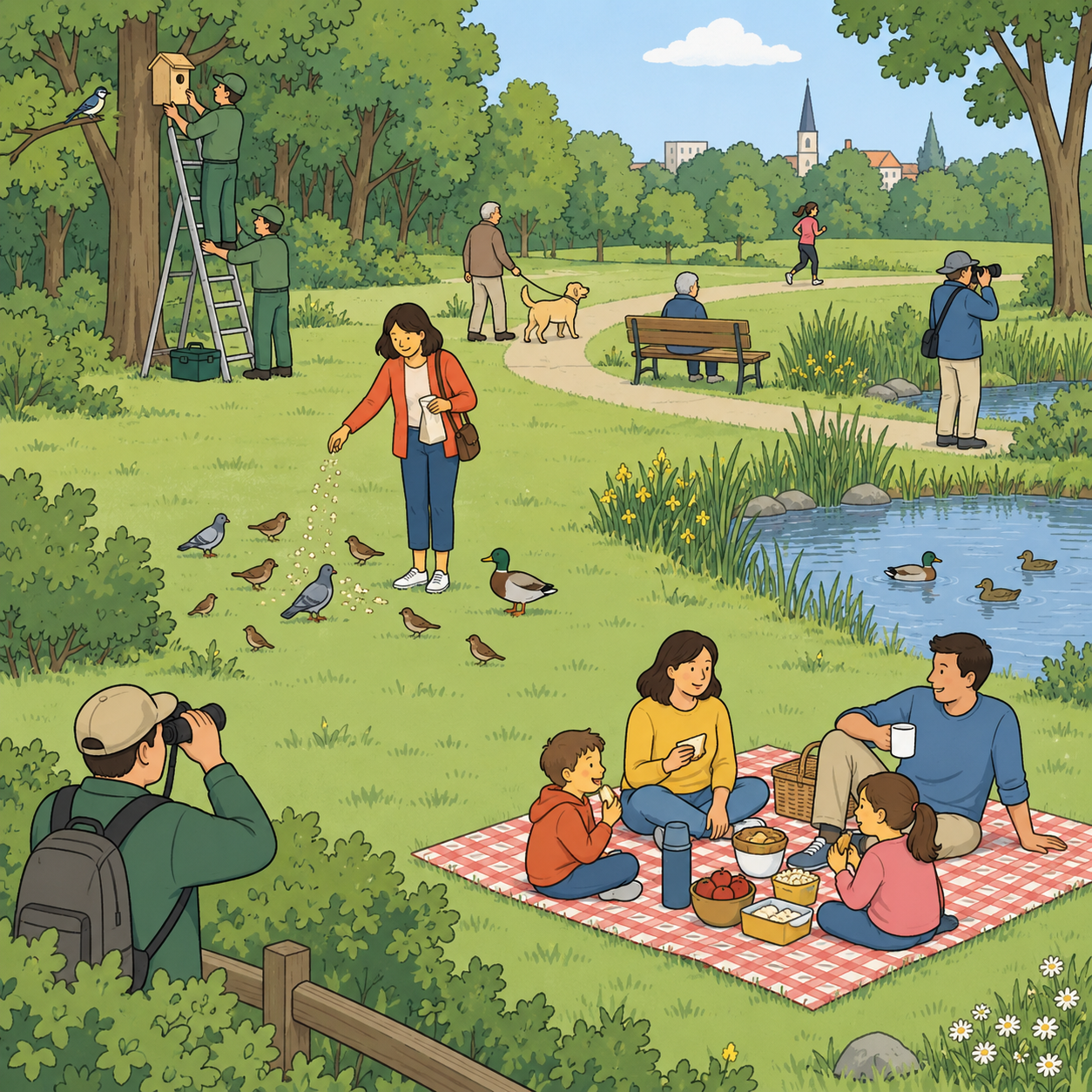
A description can begin with the family in the foreground, move to the woman near the centre and then describe the workers on the left. People engaged in the same activity can be connected instead of introduced as unrelated details. Actions and clothing distinguish the groups, while variation in adjectives and verbs avoids unnecessary repetition.
“A man can be seen looking through binoculars beside the pond” uses a passive construction. Background details such as trees, paths and buildings help establish the setting. Meticulously means very carefully, and at ease means relaxed; these expressions are useful only when they fit the visible activity or state.
An unfamiliar game or sport does not have to stop the description. The people, what they are holding and the actions that can be explained may provide enough useful material. Select the groups that can be described clearly rather than leaving a long empty pause over one activity.
A small bank of accurate scene vocabulary makes these choices easier:
| Scene | Words and combinations to practise |
|---|---|
| A road incident | a collision; a head-on collision; a sedan; a witness; paramedics; a U-turn; a detour |
| A kitchen | a kitchen island; a countertop; dough; bite-sized pieces |
| A farm | a mower; a trailer; hay; a barn; a bungalow |
| Clothing and appearance | ginger hair; a plaid shirt |
A collision is a crash; collusion means secret cooperation for an improper purpose and would change the meaning. Distinguish a mower used to cut grass from a tractor, and use hay for dried grass used as animal feed. The precise word should describe the object or action rather than simply sound advanced.
In a prediction, before, after and then connect next actions. The worker may finish attaching the birdhouse and then climb down while the other holds the ladder. The family may put food away after eating so that they can pack up. These short sequences connect a reasonable future with the visible situation. Complicated grammar adds little if the relationship between the ideas remains unclear.
Build usable action words and pronunciation habits
A practical verb list can help when the action is understood but the word is missing. Useful verbs include gather, group, assemble, save and compile. They are not interchangeable in every sentence. Check the meaning and use the word in an actual description rather than collecting difficult verbs that cannot yet be used.
When describing unusual music-making, distinguish the objects, actions and sounds. Someone might assemble plastic and metal containers into a drum kit and strike them to create a rhythm. Another performer may use glasses containing different amounts of water to produce different tones. A drum can sound loud, while a glass may produce a delicate sound. These contrasts communicate more than repeating “beautiful sound” for every instrument.
Pronunciation practice can be brief and regular. Ten minutes of attentive repetition provides repeated opportunities to notice sounds, stress and the way words join together. Listen to a reliable model, repeat it and identify what still needs work. Return the words to full sentences so that accurate individual sounds become usable in a complete response.