CELPIP Speaking Task 4: Making Predictions
Predict what happens next in 60 seconds: clue, next action and consequence, an adaptable template and an original sample answer.
Independent review record
The framework was reviewed on October 9, 2026 by a separate AI reviewer. The cafe image and revised sample below were added afterward and checked against the supplied picture. This was not an official CELPIP assessment.
Conclusion: compatible with the published 2026 task format. The sample makes plausible predictions from the supplied image; no recording or timed unseen-prompt performance was assessed, and no band score is assigned.
These are original teaching materials, not official answers. A reusable structure can help you organize a response, but it has no score of its own. Replace the content for every prompt. The examples have not been rated by CELPIP.
Preparation :30s
Recording :60s
Task and timing
Preparation: 30 seconds. Speaking: 60 seconds. Predict what will happen next in the same illustration used for Task 3. See the official 2026 Speaking Pro pack, pages 5 and 18.
Response plan
For each prediction, use visible clue → likely next action → plausible consequence.
- 10–5 secondsIntroduce a likely development.
- 25–22 secondsDevelop the first prediction.
- 322–39 secondsDevelop another person's next action.
- 439–56 secondsAdd a further supported possibility.
- 556–60 secondsOptional brief closing.
Three predictions are a useful practice structure, not a published scoring threshold. Develop the best-supported ideas instead of inventing unrelated events.
Adaptable template
- 1
Over the next few moments, I think likely development.
- 2
The clearly identified person will probably next action, since visible clue. Once complete clause describing that event, likely consequence.
- 3
Meanwhile, complete clause using is/are likely to + a next action. Explain the visible clue in a complete sentence.
- 4
There's also a chance that another development. If condition supported by the scene, plausible result.
Move the scene forward. Simply changing “is walking” to “will be walking” may add little if you never explain what happens next.
Choosing the degree of certainty
| Evidence | Useful expression | Example |
|---|---|---|
| An action appears imminent | is about to | She is about to pay; she is holding out her card. |
| A likely next step | will probably; is likely to | The people in line will probably enter when the door opens. |
| One possible development | might; may | The child might ask someone to help carry the bag. |
| A conditional outcome | if…, … may… | If the box tips over, some books may fall out. |
“Is about to” means an action is going to start very soon, not that it has already started and is nearly finished.
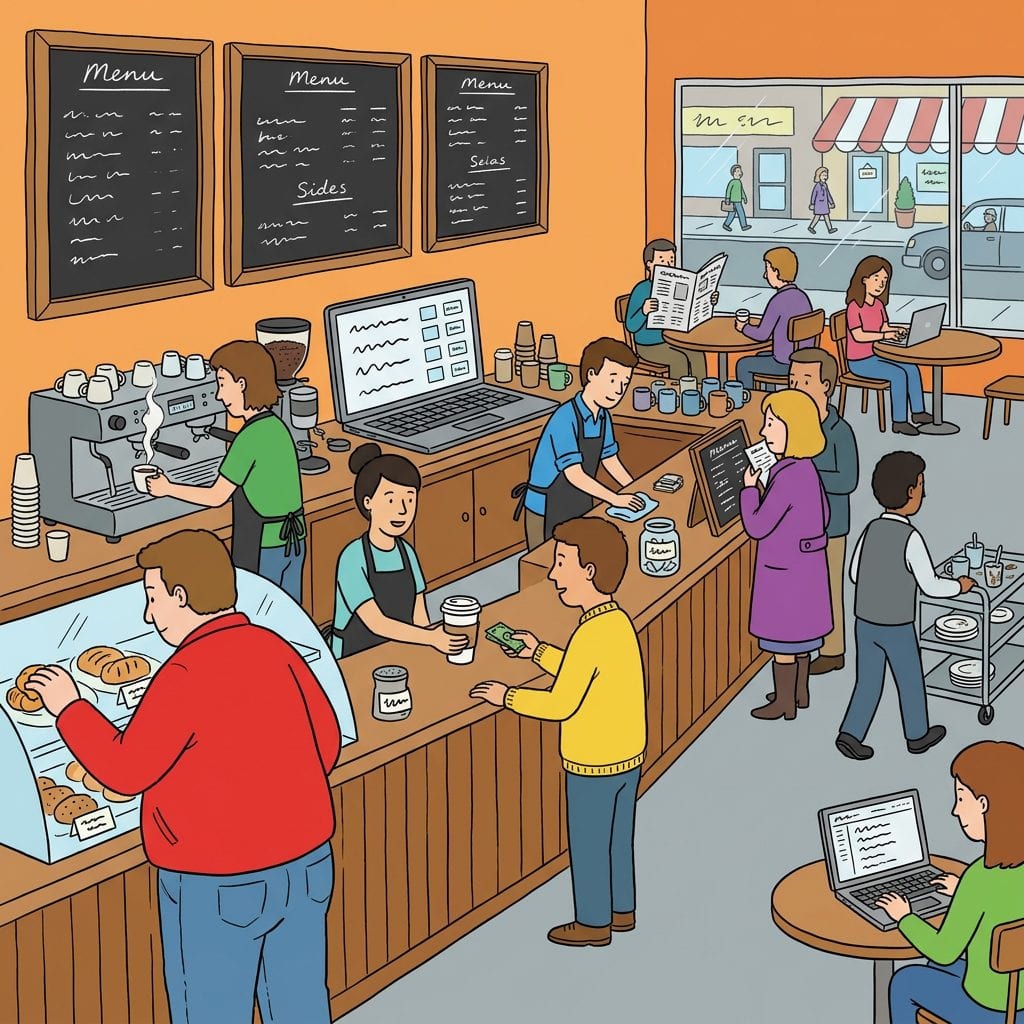
Shared practice image
Use this same user-supplied picture for Speaking Tasks 3 and 4. The following prompt and response are original practice material, not an official CELPIP test item.
Original practice prompt
Look at the picture and predict what will happen next. Explain your predictions using details you can see.
Original sample response
Preparation :30s
Recording :60s
The man in the yellow sweater will probably hand over his cash and take the drink the employee is offering him. Once he's paid, I expect him to move away from the counter so someone else can be served.
Meanwhile, the man in red may choose a pastry from the display. He's looking closely at the selection, so he might ask a staff member to get one for him and add it to his order.
On the right, the worker beside the trolley is likely to take the cups and plates away to be washed. After unloading it, he may return to clear more tables. That would leave space for other customers to sit down as the cafe continues serving people.
What the sample demonstrates
The predictions draw on three visible clues: cash and an offered cup, a customer examining pastries, and a trolley holding dishes. The response advances these activities rather than repeating the description. Choosing a pastry, washing the dishes, and returning to clear tables are plausible inferences, not facts already visible in the image.
High-score relevance and limits
The reasoning is grounded in the supplied picture, but the predicted events remain possibilities. The image does not show the eventual outcome. Without a recording, fluency, pronunciation, and live delivery cannot be assessed, so no complete Speaking score is assigned.
For stronger practice, make each prediction distinct, keep the time horizon close to the pictured moment, and vary sentence structure without forcing complicated grammar.
Description versus prediction
Try the template on a real question
A template feels natural only after you use it under time pressure. Pick a question and set a timer.
Practice speaking